Back to the assembly : A comparative study of parliamentary transitions in 2011 and 2026 (Article)

118
By Phyo Lin Aung
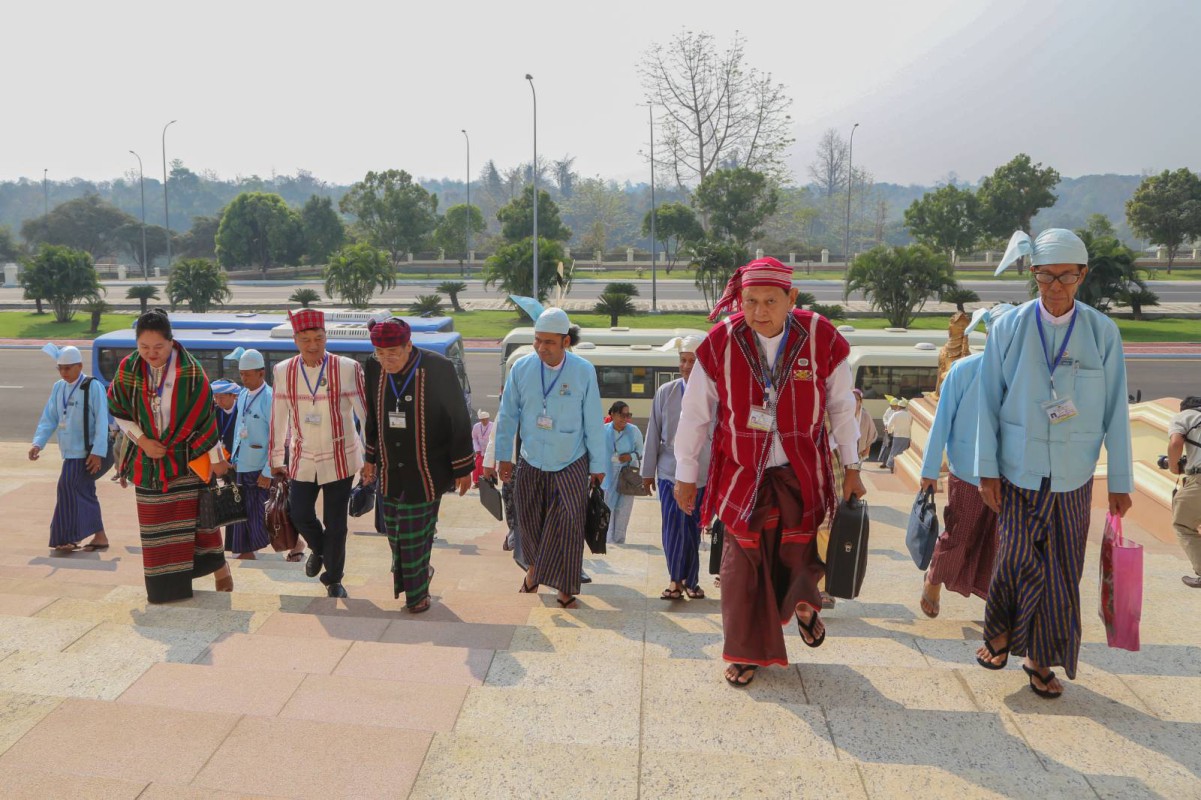
The regular sessions of the Third Parliament, convened in Naypyidaw on March 16, and 18 have emerged as a significant new milestone in Myanmar’s political history, giving tangible form to the country’s future “new democratic government.” With the revival of the parliamentary mechanism that had been suspended for five years, the resulting political landscape bears a strong resemblance to the structured transition of 2010, when Senior General Than Shwe transferred power to the civilian government of President U Thein Sein.
A comparative analysis of two power transition processes
Both the 2011 and 2026 transitions of power represent processes of transformation from military or temporary governance to civilian rule; however, the contexts in which they unfolded reveal both notable similarities and important differences.
In 2011, the State Peace and Development Council (SPDC) implemented a “7-step roadmap” that took nearly eight years to materialize, culminating in a structured transfer of authority. Similarly, the 2026 transition has been undertaken within 5 years and guided by the “5-step roadmap” of the State Administration Council (SAC), alongside the four primary objectives set by the National Defense and Security Council (NDSC).
A key similarity between the two periods lies in their adherence to a constitutional framework, which provided a degree of institutional legitimacy to both transitions. However, a critical difference is evident in the trajectory of the 2026 process, which has gradually moved beyond emergency provisions under the guidance of the NDSC and facilitated a return to parliamentary politics. This evolution suggests a more adaptive and phased transition compared to the relatively linear process observed in 2011.
Furthermore, in terms of electoral system and representation, in 2011, only 37 parties competed and the FPTP system was used, which resulted in the dominance of large parties and limited seats for ethnic parties. However, in 2026, a new MMP/PR (Proportional Representation) system was adopted and out of 57 parties competing, more than 30 parties entered the parliament, creating a broader ethnic representation and a new political landscape than before.
In terms of territorial control, while the 2011 government inherited a relatively consolidated governance apparatus, the 2026 administration faces ongoing challenges in restoring effective administrative control in conflict-affected areas, particularly in northern Shan State and Rakhine State. These areas, temporarily abandoned or weakened by armed conflict, require sustained governance efforts and negotiation with ethnic armed organizations. The capacity to stabilize these regions will be a key measure of the government’s effectiveness and legitimacy.
Geopolitically, while international optimism was high in 2011 and economic sanctions were rapidly eased, in 2026, amid increasingly complex geopolitical dynamics, the new government may have to focus more on gaining recognition from neighboring and regional powers.
Parliamentary leadership and new form of government
The leadership of the third parliament is clearly a mix of experienced politicians and those who have transitioned from the military to civilian administration. Pyithu Hluttaw Speaker U Khin Yi previously served as the Police Chief, Union Minister for Immigration and Population, and is also the chairman of the USDP party. Along with him, U Maung Maung Ohn, who will serve as the deputy speaker, is a former military officer who has served as the Chief Minister of Rakhine State and the Union Minister for Information.
U Aung Lin Dwe, who has become the speaker of the Amyotha Hluttaw, served as the Judge Advocate General of the Tatmadaw, as well as the chief executive of the National Defense and Security Council and as the secretary of the SAC, where he was responsible for key policy issues. Deputy Speaker Jeng Phang Naw Taung, an ethnic representative, has served as the Union Minister for Sports and Youth Affairs and the Ministry of Hotels and Tourism, so he has a combination of administrative and parliamentary experience.
Although the full administrative and executive structures have not been formally finalized by the time of writing, it was anticipated that this emerging power-sharing arrangement would contribute to a more systematic system of checks and balances among the legislative, executive, and judicial branches. While the leaders stepped down in 2011 and the transition to a civilian government took place, the transition in 2026 will see a significant shift towards a form of power-balancing through new institutions such as the “Union Consultative Council” where a diverse range of political forces will be involved.
The new government's priorities and challenges ahead
The new democratic government's priorities in 2026 are national stability and economic recovery. While the 2011 transition was defined by the pursuit of "democratic reform", the urgent task now of the 2026 transition is "national stability and restoration".
The new government must focus on territorial control efforts to re-establish administrative control in the temporarily abandoned areas of northern Shan State and Rakhine State. It must also engage in political discussions in parliament to overcome international economic sanctions through diplomacy, improve the socio-economic lives of the people, and establish a union based on national unity.
In conclusion, while the 2011 transition was primarily focused on “democratic reform” and political liberalization, the 2026 transition is fundamentally centered on “national stability, restoration, and institutional consolidation.” Although both processes followed structured roadmaps initiated by the Tatmadaw, the 2026 government faces a far more complex set of domestic and international challenges than its 2011 predecessor.
Nevertheless, with the reactivation of parliamentary politics and legislative institutions, there remains a critical opportunity to navigate these challenges in a manner that prioritizes the interests and welfare of the people, while striving to build a parliament and a government that are both legitimate and broadly trusted by the public. –