World's Tallest Sitting Marble Buddha in Nay Pyi Taw: The Maravijaya Image

108
HSU (NP News) - March 27
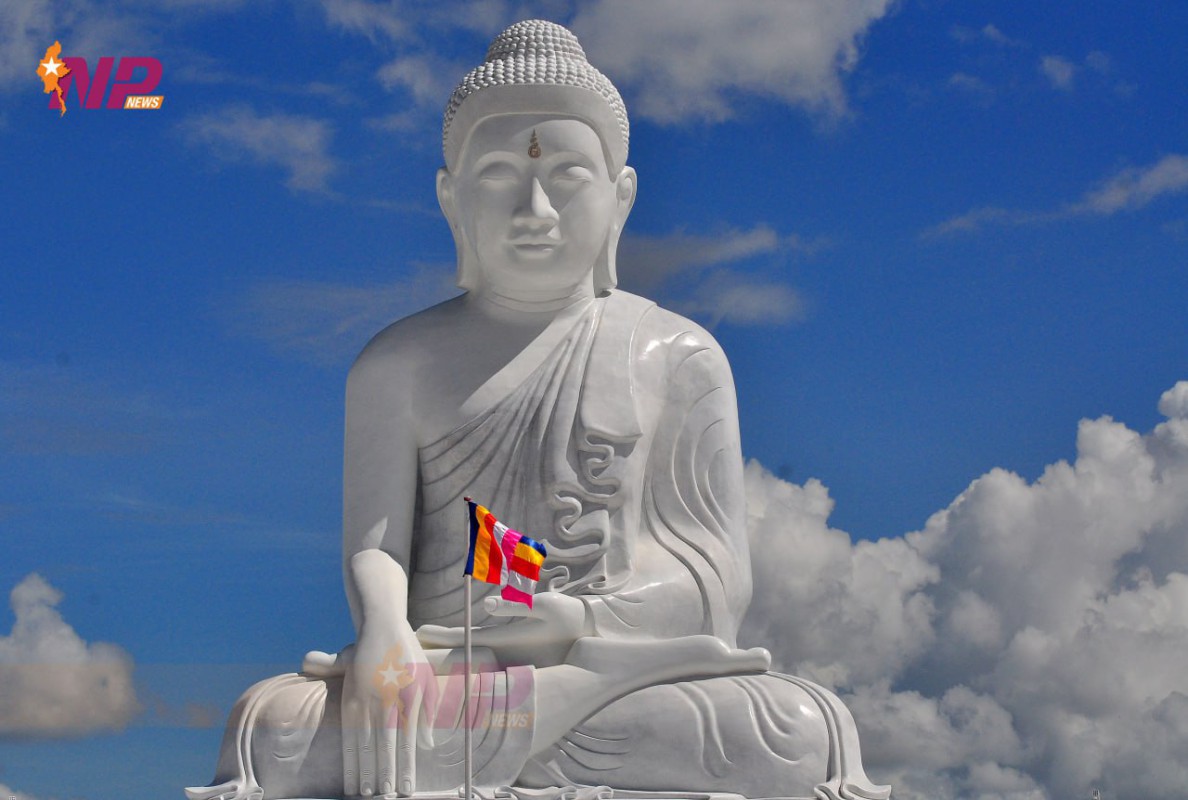
In the quiet expanse of Dekkhinathiri Township, on the eastern fringe of Myanmar's capital, a monumental figure now gazes out over the landscape with serene composure. The Maravijaya Buddha Image, the world's tallest sitting marble Buddha, has been consecrated in a sprawling new park, marking a significant milestone in the country's religious and cultural history. Rising to a total height of 81 feet (25 meters), including an 18-foot throne, this colossus of white marble is not merely a feat of engineering but a profound statement of faith, designed to serve as a global epicenter for Theravada Buddhism.
The image depicts the Bhumi Phassa Mudra, or "calling the earth to witness" posture, symbolising the moment Siddhartha Gautama attained enlightenment by overcoming the demon Māra. This posture, known as Māravijaya—"Victory over Māra"—represents the triumph of wisdom over worldly temptation, fear, and illusion. The serene facial expression of the Buddha, carved with meticulous detail, invites contemplation, while the sheer scale of the monument inspires awe.
A Monument Forged with Modern Technology and Ancient Faith
The journey of the Maravijaya Buddha from a raw mountain rock to a sacred icon is an epic tale of logistics, advanced engineering, and national devotion. The sacred marble was quarried from the legendary Sagyin (Marble) Hill in Madaya Township, a site traditionally known for its high-quality stone. The challenge, however, was moving these massive blocks, weighing thousands of tons, to the construction site in Nay Pyi Taw.
In a complex operation, the marble pieces were first transported by waterway to the Hsimeekhon Jetty. From there, they were loaded onto specialized modular trailers for the arduous journey along the Mandalay-Yangon Expressway to the capital. Upon arrival at the Buddha Park, the real work began. Unlike the ancient sculptors who relied solely on hammer and chisel, modern technicians employed high-tech Computer Numerical Control (CNC) machines to execute the initial rough carving with precision.
The Buddha image was carved in four main sections. The first three parts, weighing a combined 1,700 tonnes, were successfully conveyed and settled onto the jewelled throne at the end of January 2023. In a meticulously planned operation, the fourth and final section was transported using a skid rail system and carefully maneuvered into place with hydraulic jacks. It was successfully settled on the throne at 2:43 am on 13 February 2023, a moment that marked the physical completion of the Buddha's form.
By March 2022, all carving processes had been completed, and the subsequent months were dedicated to the intricate work of assembly and consecration. The throne itself is a substantial structure, weighing 3,510 tonnes, bringing the total weight of the monument to an astonishing 5,292 tonnes.
The Grandeur of the Maravijaya Buddha Park
The Maravijaya Buddha is the centerpiece of a much larger religious complex designed to be a comprehensive centre for Buddhist learning and practice. The park is being developed with a vision that echoes the great royal foundations of Myanmar's past, drawing conceptual inspiration from the architectural styles of the Yadanabon era, reminiscent of the famed Atumashi
Monastery and Shwezigon Pagoda in Mandalay.
Surrounding the central image are numerous religious edifices designed for both worship and the preservation of Buddhist scripture. A key feature is the Sasana Beikman, a large hall capable of accommodating 1,200 members of the Sangha and lay devotees during religious ceremonies. The park also includes Gandha Kuti buildings (relic chambers), a fountain square, the Mucalinda Lake complete with a Nagayon pagoda, and multiple archways.
At night, the entire complex is transformed. Stupas, prayer halls, and the main platform are illuminated with electric lights, creating a serene and ethereal atmosphere that allows for evening pilgrimage and quiet reflection.
The World's Largest "Book" of Stone Inscriptions
Perhaps the most academically significant feature of the Maravijaya compound is the ambitious project to create a library of Buddhist canons in stone. Modelled after the world-famous Maha Lawkamarazein Kuthodaw Pagoda in Mandalay—often called the "world's largest book"—the Maravijaya Park will feature 729 stone inscription chambers, mirroring the number at the UNESCO-recognized site in Mandalay.
Under the guidance of five State Ovadacariya Sayadaws and following the advice of the State Sangha Maha Nayaka Committee, the entire Tipitaka (Buddhist canon), along with the Atthakatha and Tika (commentaries), are being inscribed on marble plaques. A total of 1,032 small pagodas have been built to house these treatises: 96 for the Vinaya, 216 for the Abhidhamma, and 720 for the Suttanta.
Crucially, these texts are being inscribed not only in Pali but also in Romanized script, making them accessible to an international audience of scholars and practitioners. A plan is also underway to print these canons for distribution to monasteries across the world, furthering the goal of making Myanmar a focal point for Theravada Buddhism. Pilgrims visiting the Buddha will be able to view these stone inscriptions, effectively allowing them to "read" the teachings of the Buddha while paying homage to his image.
Why the Maravijaya Buddha is Worth Visiting
For the devout Buddhist, the Maravijaya Buddha represents a supreme field of merit. The site has already hosted grand ceremonies to enshrine precious gems and religious objects donated by well-wishers from across the country into the reliquaries of the throne, acts believed to bring peace and prosperity. Visiting the image is an opportunity to witness the flourishing of the Sasana (the teachings) in the modern era.
For the traveller and cultural enthusiast, the site offers a unique window into contemporary Myanmar. It is a place where ancient tradition meets 21st-century technology. The scale of the project is staggering; it was entirely built by Myanmar's own engineers and technicians, a point of national pride that showcases the country's capabilities without foreign involvement. As one of the most prominent landmarks in Nay Pyi Taw—a city known for its spacious boulevards and government institutions—the Maravijaya Buddha Park provides a spiritual and cultural heart to the administrative capital.
The park is designed to be more than just a tourist stop; it is a place for contemplation. The carefully manicured grounds, the peaceful lake, and the majestic image itself create an atmosphere conducive to meditation and reflection. Whether one comes to study the inscribed scriptures, to marvel at the engineering prowess required to move and carve a 5,000-ton statue, or simply to sit in the presence of one of the world's most impressive religious monuments, the Maravijaya Buddha offers a profound experience.
Consecrated in a grand ceremony on 1 August 2023, attended by members of the Sangha from nine countries, the Maravijaya Buddha Image now stands ready to receive pilgrims and visitors from around the globe. It is a testament to the enduring power of faith in Myanmar, a modern marvel carved from ancient stone, inviting the world to come and witness the victory of wisdom.